
Vote for the Next Book (#24)
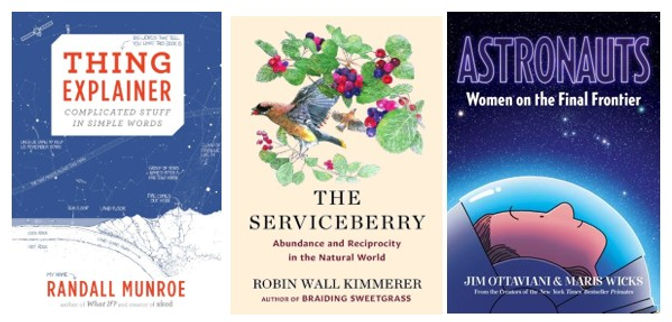
Thing Explainer: Complicated Stuff in Simple Words
by Randall Munroe
-
Humor, Reference, Technology, Engineering, Illustrated
-
64 pages, first published 2015
-
Available at 130 Michigan Libraries
-
Goodreads Choice Award: Nominee for Readers' Favorite Science & Technology (2016)
-
"In Thing Explainer: Complicated Stuff in Simple Words, things are explained in the style of Up Goer Five, using only drawings and a vocabulary of the 1,000 (or "ten hundred") most common words. Explore computer buildings (datacenters), the flat rocks we live on (tectonic plates), the things you use to steer a plane (airliner cockpit controls), and the little bags of water you're made of (cells).” – GoodReads
The Serviceberry: Abundance and Reciprocity in the Natural World
by Robin Wall Kimmerer
-
Nature, Ecology, Indigenous, Environment, Philosophy
-
112 pages, first published 2024
-
Available at 239 Michigan Libraries
-
Goodreads Choice Award: Nominee for Readers' Favorite Nonfiction (2025)
-
“As Indigenous scientist Robin Wall Kimmerer harvests Serviceberries alongside the birds, she considers the ethic of reciprocity that lies at the heart of the gift economy. How, she asks, can we learn from Indigenous wisdom and the plant world to reimagine what we value most? Our economy is rooted in scarcity, competition, and the hoarding of resources, and we have surrendered our values to a system that actively harms what we love. Meanwhile, the Serviceberry’s relationship with the natural world is an embodiment of interconnectedness and gratitude. The tree distributes its wealth—its abundance of sweet, juicy berries—to meet the needs of its natural community. And this distribution ensures its own survival. As Kimmerer explains, “Serviceberries show us another model, one based upon reciprocity, rather than accumulation, where wealth and security come from the quality of your relationships, not from the illusion of self-sufficiency."” – GoodReads
Astronauts: Women on the Final Frontier
by Jim Ottaviani, Maris Wicks (Illustrator)
-
Graphic Novel, History, Space, Biography
-
176 pages, first published 2020
-
Nominee for Readers' Favorite Nonfiction (2025) Goodreads Choice Award
-
Available at 75+ Michigan Libraries
-
“The U.S. may have put the first man on the moon, but it was the Soviet space program that made Valentina Tereshkova the first woman in space. It took years to catch up, but soon NASA’s first female astronauts were racing past milestones of their own. The trail-blazing women of Group 9, NASA’s first mixed gender class, had the challenging task of convincing the powers that be that a woman’s place is in space, but they discovered that NASA had plenty to learn about how to make space travel possible for everyone ." - GoodReads
Vote for the Next Book (#25)
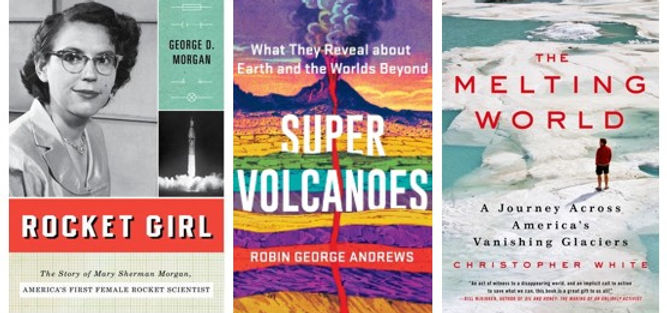
Rocket Girl: The Story of Mary Sherman Morgan, America’s First Female Rocket Scientist
by George D. Morgan
-
Biography, History, Space, Feminism, American History
-
334 pages, first published 2013
-
Available at 29 Michigan Libraries
-
"In 1938, a young German rocket enthusiast named Wernher von Braun had dreams of building a rocket that could fly him to the moon. In Ray, North Dakota, a young farm girl named Mary Sherman was attending high school. In an age when girls rarely dreamed of a career in science, Mary wanted to be a chemist. A decade later the dreams of these two disparate individuals would coalesce in ways neither could have imagined. World War II and the Cold War space race with the Russians changed the fates of both von Braun and Mary Sherman Morgan. When von Braun and other top engineers could not find a solution to the repeated failures that plagued the nascent U.S. rocket program, North American Aviation, where Sherman Morgan then worked, was given the challenge. Recognizing her talent for chemistry, company management turned the assignment over to young Mary. In the end, America succeeded in launching rockets into space, but only because of the joint efforts of the brilliant farm girl from North Dakota and the famous German scientist. While von Braun went on to become a high-profile figure in NASA's manned space flight, Mary Sherman Morgan and her contributions fell into obscurity--until now." – GoodReads
Super Volcanoes: What They Reveal about Earth and the Worlds Beyond
by Robin George Andrews
-
Geology, History, Natural History
-
336 pages, first published 2021
-
Available at 63 Michigan Libraries
-
A lively and utterly fascinating guide to these geologic wonders, Super Volcanoes revels in the incomparable power of volcanic eruptions past and present, Earthbound and otherwise—and recounts the daring and sometimes death-defying careers of the scientists who study them. Science journalist and volcanologist Robin George Andrews explores how these eruptions reveal secrets about the worlds to which they belong, describing the stunning ways in which volcanoes can sculpt the sea, land, and sky, and even influence the machinery that makes or breaks the existence of life.
Walking us through the mechanics of some of the most infamous eruptions on Earth, Andrews outlines what we know about how volcanoes form, erupt, and evolve, as well as what scientists are still trying to puzzle out. How can we better predict when a deadly eruption will occur—and protect communities in the danger zone? Is Earth’s system of plate tectonics, unique in the solar system, the best way to forge a planet that supports life? And if life can survive and even thrive in Earth’s extreme volcanic environments—superhot, superacidic, and supersaline surroundings previously thought to be completely inhospitable—where else in the universe might we find it?” – GoodReads
The Melting World: A Journey Across America’s Vanishing Glaciers
by Christopher White
-
Nature, Climate Change, Environment
-
288 pages, first published 2013
-
Available at 14 Michigan Libraries
-
“Global warming usually seems to happen far away, but one catastrophic effect of climate change is underway right now in the Rocky Mountains. In The Melting World, Chris White travels to Montana to chronicle the work of Dan Fagre, a climate scientist and ecologist, whose work shows that alpine glaciers are vanishing rapidly close to home. For years, Fagre has monitored the ice sheets in Glacier National Park proving that they—and by extension all Rocky Mountain ice—will melt far faster than previously imagined. How long will the ice fields survive? What are the consequences on our environment? The Melting World chronicles the first extinction of a mountain ecosystem in what is expected to be a series of such global calamities as humanity faces the prospect of a world without alpine ice." -GoodReads
Vote for the Next Book (#26)

The Body: A Guide for Occupants
by Bill Bryson
-
Health, Biology, Medicine, History, Humor
-
450 pages, first published 2019
-
Literary awards: Royal Society Science Book Prize Nominee (2020), PEN/E.O. Wilson Literary Science Writing Award Nominee for Longlist (2020), Goodreads Choice Award Nominee for Science & Technology (2019)
-
Available at 247 Michigan Libraries
-
"In the bestselling, prize-winning A Short History of Nearly Everything, Bill Bryson achieved the seemingly impossible by making the science of our world both understandable and entertaining to millions of people around the globe.
Now he turns his attention inwards to explore the human body, how it functions and its remarkable ability to heal itself. Full of extraordinary facts and astonishing stories, The Body: A Guide for Occupants is a brilliant, often very funny attempt to understand the miracle of our physical and neurological make up." – GoodReads
Off the Spectrum: Why the Science of Autism Has failed Women and Girls
by Gina Rippon
-
Psychology, Mental Health, Feminism, Health, Disability
-
352 pages, first published 2025
-
Available at 64 Michigan Libraries
-
“In Off the Spectrum cognitive neuroscientist Gina Rippon sheds light on how old ideas about autism leave women behind and how the scientific community must catch up. Generations of researchers, convinced autism was a male problem, simply didn’t bother looking for it in women, creating a snowball effect of biased research.
To correct this “male spotlight” problem Rippon outlines how autism presents differently in girls and women—such as how they tend to camouflage autistic traits, or how their intense interests may take a form considered more socially acceptable. When autism studies don’t recruit female subjects, Rippon argues, it’s not only autistic women who are failed; it’s the entire scientific community. Correcting a major scientific bias, Off the Spectrum provides a much-needed exploration of autism in women to parents, clinicians, and autistic women themselves.” – GoodReads
The Giant Leap: Why Space Is the Next Frontier in the Evolution of Life
by Caleb Scharf
-
Space, Astronomy, Technolgoy
-
368 pages, first published 2025
-
Available at 17Michigan Libraries
-
“In The Giant Leap, planetary scientist Caleb Scharf argues that our journey into space isn’t simply a giant leap for humankind—it’s life’s next great transition, an evolution of evolution itself. Humans and our technology are catalysts for an interplanetary transformation, marking a disruption in the story of life as fundamental as life’s movement from sea to land, and land to sky.
Inspired by Darwin’s account of his journey on the Beagle, The Giant Leap thrills at both life’s creativity and the marvels of technology that have propelled us into the cosmos. And it offers an awesome glimpse of the grander vistas that wait in the great beyond." -GoodReads